

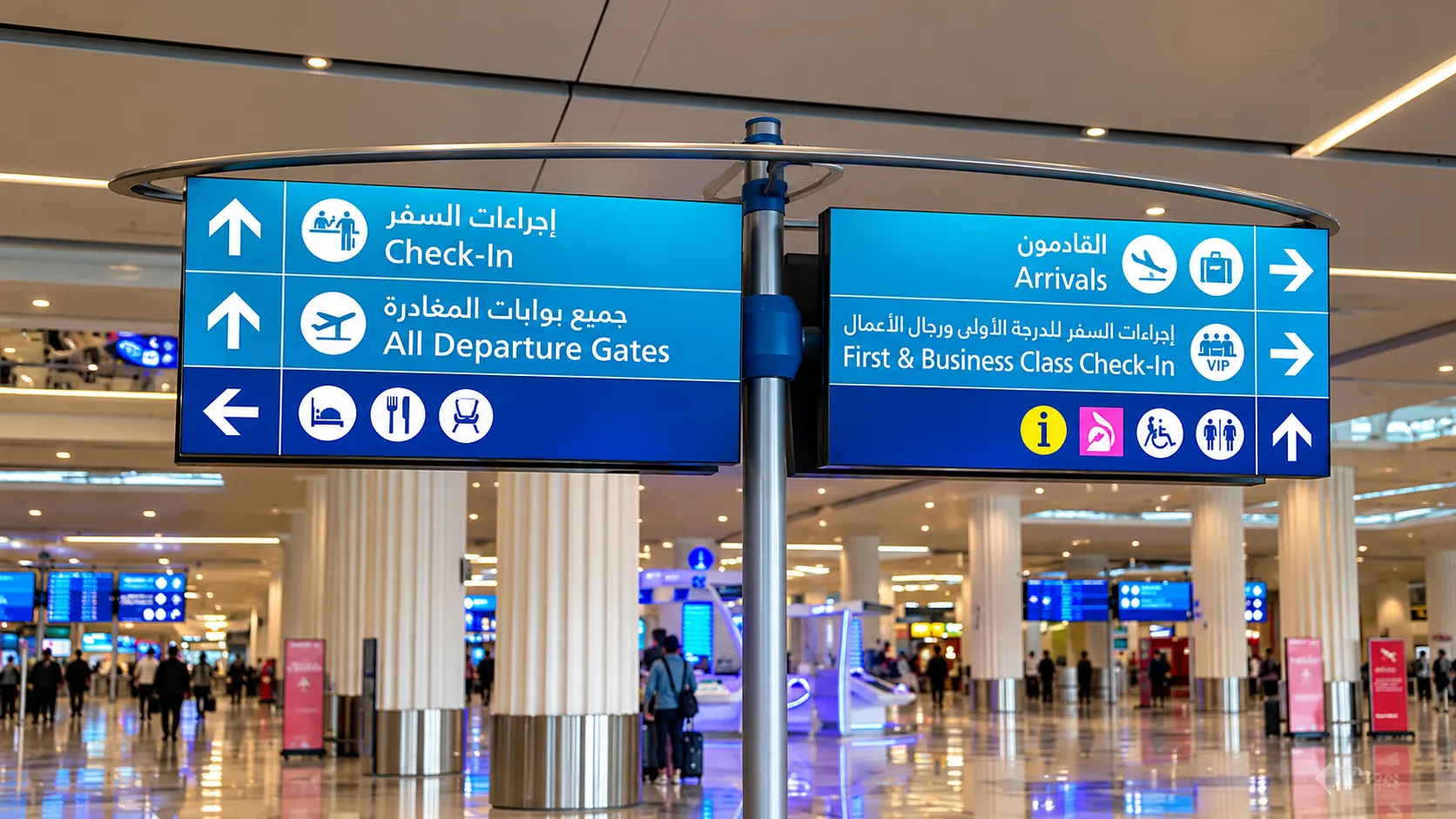
Finding the right destination should be easy, whether someone is visiting a corporate office, shopping mall, hotel, hospital, school or commercial building. Clear signs help people navigate unfamiliar spaces, locate important facilities and reach their destinations without unnecessary confusion. This is why wayfinding signage in Dubai is an essential part of modern commercial interiors, public spaces and business environments.
Dubai’s buildings and commercial developments often include multiple floors, departments, entrances, parking areas and visitor facilities. Without an organised signage system, visitors may struggle to find reception desks, meeting rooms, lifts, restrooms or specific business units.
A well-planned wayfinding system combines directional signs, building directories, identification signs and information boards to create a consistent navigation experience. For businesses looking to improve visitor convenience and maintain a professional environment, custom signage can provide a practical, long-term solution.
In this guide, M Print House explains the different types of wayfinding signs, the materials available, important design considerations, common applications and how to choose the right signage solution for your premises.
What Is Wayfinding Signage?
Wayfinding signage is a coordinated system of signs that helps people understand their surroundings and navigate a location. It communicates where visitors are, where they need to go and which direction they should follow.
Unlike a single directional board, an effective wayfinding system considers the complete visitor journey. Signs work together at entrances, corridors, intersections, lifts, staircases and destination points.
For example, someone entering an office building may first check a directory to identify a company, follow directional signs to the correct floor and then use an identification sign to locate the office.
An effective wayfinding system generally includes four main functions:
- Identification: Confirms the name or identity of a destination.
- Direction: Shows visitors which route to follow.
- Information: Provides maps, floor directories and location details.
- Regulation: Communicates important instructions, restrictions and required notices.
Combining these functions helps create a more organised and accessible environment for employees, customers, residents and visitors.
Why Is Wayfinding Signage in Dubai Important?
Businesses in Dubai serve people from different countries, language backgrounds and levels of familiarity with a building. Clear visual communication can make a substantial difference to the visitor experience.
1. Makes Navigation Easier
Directional arrows, floor indicators and room identification signs help people reach their destinations more independently. This is particularly useful in large offices, shopping centres, hospitals, hotels and multi-storey buildings.
2. Improves the Visitor Experience
Visitors should not have to ask for directions repeatedly. Strategically positioned signs help them move confidently through a property, making visits more convenient for customers, guests and business partners.
3. Strengthens Brand Identity
Custom signage can incorporate a company’s colours, typography, logo and visual style. When applied consistently across reception areas, corridors and departments, it contributes to a professional brand experience.
4. Supports Staff and Facility Operations
Employees, delivery personnel, contractors and visitors benefit from clear information about departments, service areas, meeting rooms and restricted spaces. A well-organised system can reduce repeated enquiries at reception.
5. Helps People Navigate Large Properties
Hotels, healthcare facilities, campuses, industrial facilities and commercial developments may contain many interconnected spaces. A coordinated signage plan helps people understand the layout and follow the correct route.
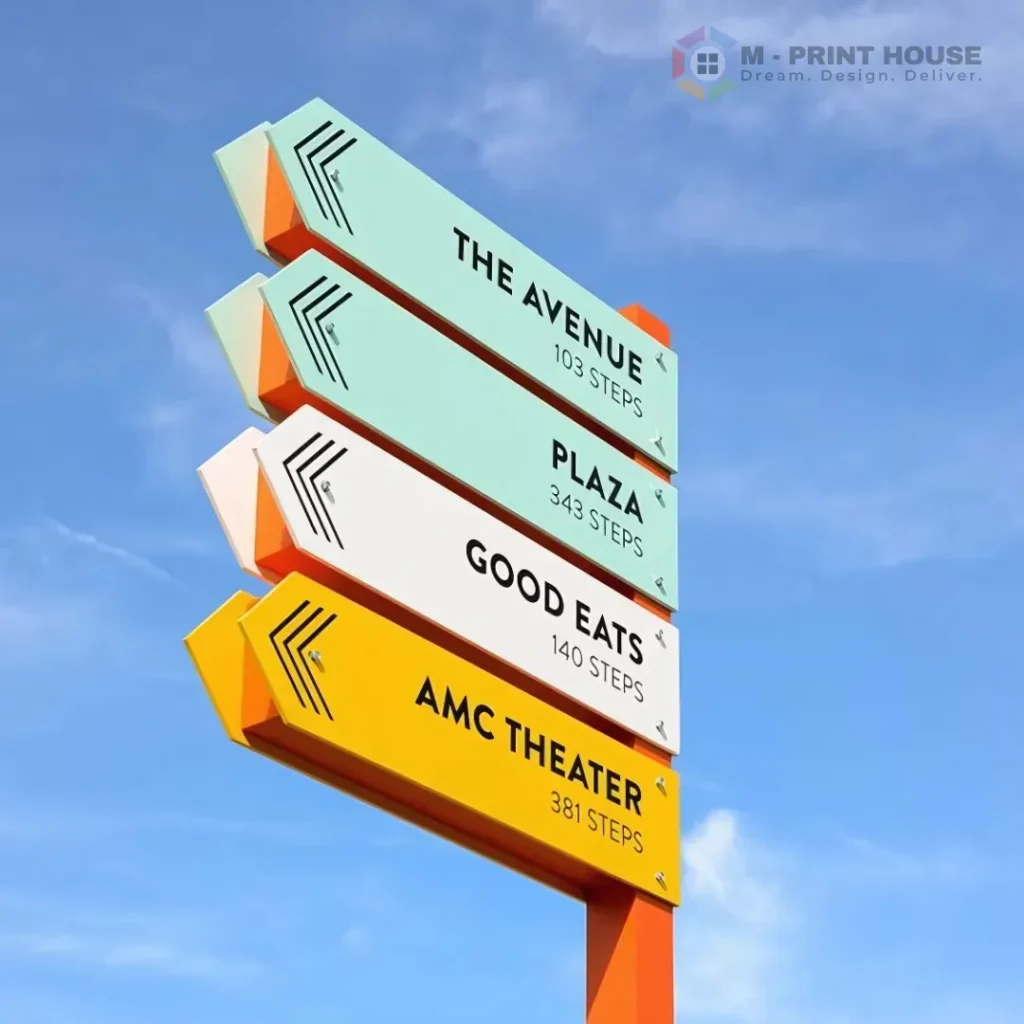


Types of Wayfinding Signage for Businesses
Different environments require different signs. Selecting the appropriate combination depends on the building layout, visitor movement, visibility requirements and branding guidelines.
1. Directional Signage
Directional signs guide people towards specific destinations using arrows, text and universally recognisable symbols.
Typical applications include:
- Reception and customer service desks
- Lifts and staircases
- Meeting rooms and office departments
- Restrooms and waiting areas
- Parking facilities and building exits
- Retail sections and service counters
Directional signage should be positioned where people need to make a decision, such as a corridor intersection, entrance or lift lobby.
2. Directory Signage
Directory signs provide an organised overview of the businesses, departments, floors or facilities within a property.
Common examples include office building directories, mall tenant directories, hotel facility lists and floor-by-floor department boards.
A directory should present information in a clear hierarchy. Visitors should be able to scan the content quickly instead of reading a crowded collection of names and instructions.
3. Wall-Mounted Wayfinding Signs
Wall-mounted signs are fixed to walls near corridors, entrances, doors and important junctions. They are suitable for offices, clinics, educational institutions, hotels and commercial buildings.
They can identify departments, indicate directions or communicate essential visitor information while keeping floor space clear.
4. Hanging and Suspended Signs
Hanging signs are installed above corridors or pedestrian routes, making them visible from a distance. They are useful in large retail environments, warehouses, exhibition venues and buildings with long internal corridors.
Their placement should account for ceiling height, sightlines, lighting and safe overhead clearance.
5. Freestanding Directional Signs
Freestanding signs are independent structures that can be positioned in lobbies, open areas, parking facilities and event spaces.
Depending on the design, they can accommodate directional information, site maps, visitor instructions or temporary event guidance. Their stability, footprint and installation location should be considered before production.
6. Floor Directory and Information Signs
Floor directories identify departments, rooms, tenants and facilities on individual levels. They help visitors understand the building layout after exiting lifts or staircases.
These signs are especially useful in business centres, clinics, universities, serviced offices and multi-storey commercial properties.
7. Illuminated Wayfinding Signs
Illuminated signs use lighting to improve visibility in suitable indoor or outdoor environments. Backlit panels and integrated LED designs can be considered for reception areas, larger facilities and locations where additional visibility is needed.
Lighting should be selected according to the environment, viewing distance, ambient conditions and maintenance requirements.
Custom Wayfinding Signage: Materials and Finishes
Custom wayfinding signage allows businesses to select materials, dimensions, colours, graphics and mounting styles that suit their premises.
The best material depends on whether the sign will be installed indoors or outdoors, how frequently people interact with it and the appearance required.
Acrylic Signage
Acrylic offers a clean, contemporary appearance and can be used for room identification, directional panels and directories. It is available in different colours and finishes and can be combined with printed graphics or dimensional lettering.
It is often considered for corporate offices, clinics, reception areas and hospitality interiors.
Aluminium Signage
Aluminium is a practical option for many commercial applications because of its relatively low weight and corrosion resistance. It can be finished to suit different architectural and branding requirements.
Appropriately specified aluminium signage may be suitable for internal directories, wall-mounted panels and selected outdoor installations.
Stainless Steel Signage
Stainless steel creates a premium, professional appearance. It is commonly considered for corporate offices, hotels, upscale commercial interiors and environments where a refined finish is important.
The grade, finish and installation method should be selected according to the location and exposure conditions.
Aluminium Composite Panel (ACP)
ACP panels can provide a rigid, flat surface for printed graphics and directional information. They are used in various commercial signage applications, with the final specification depending on the installation environment and required durability.
Wooden Signage
Wood and wood-effect finishes can complement hospitality venues, cafés, offices and interior spaces with natural or contemporary design themes.
The selected material and protective finish should suit the intended indoor or outdoor application.
Digital and LED Signage
Digital displays can be useful where information changes regularly, such as room availability, event schedules, tenant information or visitor announcements.
They require consideration of power supply, content management, screen visibility and maintenance. Static signs may remain more practical where information changes infrequently.
How to Design Effective Wayfinding Signage
A successful signage system depends on more than attractive graphics. The information must be understandable, correctly positioned and consistent throughout the building.
Use Clear, Readable Typography
Choose legible typefaces and appropriate text sizes for the expected viewing distance. Avoid decorative fonts for essential directional information.
Use a clear hierarchy to distinguish main destinations, secondary information and supporting details.
Maintain Strong Colour Contrast
Text and symbols should stand out clearly against their backgrounds. Contrast improves readability under different lighting conditions and helps people identify important information quickly.
Brand colours can be incorporated without sacrificing legibility.
Keep Messages Short
Visitors should be able to understand a sign at a glance. Use concise destination names, straightforward arrows and familiar symbols.
Avoid overcrowding signs with unnecessary promotional messages or excessive information.
Use Consistent Symbols and Naming
The same destination should have the same name throughout the building. For example, do not alternate between several different labels for the same department.
Consistent arrows, icons, colours and terminology help people recognise information across different floors and areas.
Plan Signs Around Visitor Movement
Identify the points where visitors need information before they continue their journey.
These may include building entrances, reception desks, lift lobbies, corridor intersections, parking areas and the entrances to individual departments.
A sign placed after a decision point may be less useful than one positioned where visitors can act on the information.
Consider English and Arabic
For many Dubai commercial environments, bilingual English and Arabic signage is an important consideration. Language requirements, text hierarchy and alignment should be assessed for the building type and applicable regulations.
The Dubai Building Code includes guidance on bilingual signage, information hierarchy and positioning. Final requirements should be checked against the applicable provisions for the specific project.
Where Is Wayfinding Signage Used?
Wayfinding solutions can be adapted to different industries and building layouts.
Corporate Offices and Business Centres
Office signage helps employees and visitors locate reception, meeting rooms, departments, shared facilities and individual offices. Floor directories are particularly useful in multi-tenant buildings.
Shopping Malls and Retail Centres
Retail environments benefit from directional signs for shops, lifts, escalators, restrooms, parking areas, information counters and other facilities. Consistent navigation can make the shopping experience easier for customers.
Hotels and Hospitality Venues
Hotels may require signs for reception, guest rooms, restaurants, conference rooms, leisure facilities, parking and service areas. Signage can be designed to complement the interior concept and brand identity.
Hospitals and Healthcare Facilities
Healthcare environments need clear navigation to reception, departments, consultation rooms, laboratories, pharmacies and waiting areas. Information should be organised carefully to minimise confusion and support the needs of different visitors.
Safety and emergency signage must be planned separately where specific requirements apply.
Schools, Colleges and Universities
Educational institutions can use directional signs to identify classrooms, administration offices, libraries, laboratories, auditoriums, sports facilities and campus routes.
Warehouses and Industrial Facilities
Industrial sites may require signs for loading bays, storage zones, departments, visitor routes and restricted areas. Operational, safety and regulatory signage should be specified according to the facility’s requirements.
Residential and Mixed-Use Developments
Residential towers and mixed-use properties may benefit from clear signs for building entrances, reception, parking levels, lifts, amenities and shared facilities.
Wayfinding Signage in Dubai: Compliance and Installation Considerations
Before manufacturing and installing signage, confirm the applicable requirements for the building, property owner and relevant authority.
The Dubai Building Code contains provisions relating to wayfinding in buildings, including directories, directional signs, information hierarchy and placement. Requirements can vary according to the location, building use and type of sign.
For example, the code addresses the provision of certain orientation signs at corridor intersections and intervals, along with the need to avoid obstructing access and required means of egress.
Before approving a project, consider the following:
- Location approval: Confirm whether the sign requires landlord, building management or authority approval.
- Artwork and dimensions: Prepare drawings showing the proposed design, size, material and mounting method where required.
- Accessibility: Consider visibility, readable text, contrast and the needs of people with disabilities.
- Fire and life safety: Keep emergency and evacuation signage consistent with applicable requirements.
- Installation safety: Ensure signs are securely mounted and do not obstruct circulation, access or essential building features.
- Outdoor conditions: Specify suitable materials, fixings and finishes for exposure to sunlight, heat, moisture and dust.
For further guidance, consult the Dubai Building Code and the Dubai Municipality website. Confirm the current requirements with the relevant authority or property management team before proceeding.
How to Choose Among the Best Companies for Wayfinding Signage in Dubai
When comparing the best companies for wayfinding signage in Dubai, evaluate the quality and suitability of their proposed solutions rather than relying on price alone.
1. Review Relevant Project Experience
Look for examples of directional signs, floor directories and signage systems similar to your project. Experience with comparable buildings and applications can help identify practical design considerations.
2. Ask About Customisation
Your supplier should understand your branding requirements, building layout, preferred materials and installation conditions.
Ask whether the proposed design can accommodate your logo, corporate colours, bilingual text and future information updates.
3. Check Material and Finish Options
Request material recommendations based on the installation location and expected usage. The lowest-cost option may not be the most appropriate for a high-traffic or outdoor environment.
4. Confirm Design and Production Details
Before approval, review the artwork, dimensions, colours, text, arrows, mounting details and final layout.
For a larger project, consider a location-by-location signage schedule so that each sign has a defined purpose and position.
5. Clarify Installation and Project Coordination
Ask whether site measurements, installation planning, delivery and coordination with building management are included in the proposed scope.
Confirm the production schedule, installation responsibilities and any exclusions before approving the quotation.
6. Compare Complete Quotations
When comparing suppliers, check that quotations cover comparable materials, sizes, quantities, finishes, lighting, installation and other relevant requirements.
A detailed quotation makes it easier to compare the actual value of different proposals.
What Affects the Cost of Custom Wayfinding Signage?
The cost of custom wayfinding signage depends on the project specifications. A small set of office door signs will generally have different production requirements from a multi-floor directory system or a large outdoor directional structure.
Important cost factors include:
- Sign dimensions and total quantity
- Material type and thickness
- Printed graphics, dimensional lettering and finishing
- LED illumination or digital components
- Mounting hardware and installation complexity
- Site access and installation location
- Design requirements and the number of revisions
- Delivery schedule and project coordination
For an accurate quotation, prepare a list of sign locations, estimated dimensions, required quantities, preferred materials and installation details.
If you do not have a complete specification, begin with a floor plan or site photographs and explain the intended use of each sign. This provides a useful starting point for discussing suitable options.
Why Consider M Print House for Wayfinding Signage?
Businesses planning a new office, retail environment, hospitality venue or commercial facility need signage that combines practical navigation with a consistent visual identity.
M Print House can be considered for signage requirements where the proposed scope, material options and installation arrangements match the project’s needs.
When discussing your wayfinding project, prepare the following information:
- The building type and installation location
- A floor plan or photographs of the premises
- The approximate number and size of signs
- Your preferred materials, finishes and branding guidelines
- The required languages and directional information
- Whether delivery and installation are required
Providing these details helps establish a clearer project scope and supports a more relevant quotation.
To discuss your signage requirements, visit M Print House and contact the team through the website.
Frequently Asked Questions About Wayfinding Signage in Dubai
What is the purpose of wayfinding signage?
Wayfinding signage helps people identify their location, find destinations and follow suitable routes through a building or outdoor environment. It typically combines directional signs, directories, identification signs and information boards.
Which types of wayfinding signs are commonly used in Dubai?
Common types include wall-mounted directional signs, hanging signs, floor directories, room identification panels, freestanding signs and illuminated directional displays. The appropriate combination depends on the building layout and visitor requirements.
Can custom wayfinding signage match my company branding?
Yes. Custom signs can be designed around a company’s logo, colour palette, typography and preferred finishes. The design should maintain clear readability and consistent destination information.
Which materials are suitable for wayfinding signs?
Acrylic, aluminium, aluminium composite panels, stainless steel and wood are among the options used for different signage applications. Material selection depends on the environment, appearance, durability requirements and installation method.
How much does wayfinding signage cost in Dubai?
There is no single price for every project. Costs depend on dimensions, quantities, materials, finishes, illumination, mounting requirements and installation. A project-specific quotation is the best way to establish the expected cost.
Do wayfinding signs need to be bilingual?
English and Arabic may be required or appropriate depending on the building, application and applicable regulations. Confirm the language and accessibility requirements for your specific project before production.
How should I choose a wayfinding signage company?
Compare relevant project experience, material options, customisation, design support, quotation details, production capability and installation arrangements. Ensure the supplier understands your building layout and the purpose of each sign.
Can wayfinding signage be used outdoors?
Yes. Outdoor directional signs can be designed using suitable materials, finishes, structural supports and fixings. The specification should account for weather exposure, visibility, stability and any applicable approvals.
Conclusion: Create a Clearer Visitor Experience with Wayfinding Signage
An effective wayfinding system helps people move through buildings with greater confidence while supporting a professional and organised environment. From office directories and corridor signs to outdoor directional boards, every sign should have a clear purpose and fit into the wider navigation system.
When planning wayfinding signage in Dubai, focus on readability, consistent design, suitable materials, strategic placement and applicable compliance requirements. Comparing suppliers against the same project specifications can also help you make a more informed decision.
If you are planning a signage project for your office, commercial property, hotel, retail space or institution, visit M Print House at https://mprinthouse.ae/ to discuss your requirements and explore suitable signage options.